The Voyager Golden Record
An interactive guide to the cover of the Voyager Golden Record: how to play a record sent into interstellar space, and how to turn its sound back into pictures.
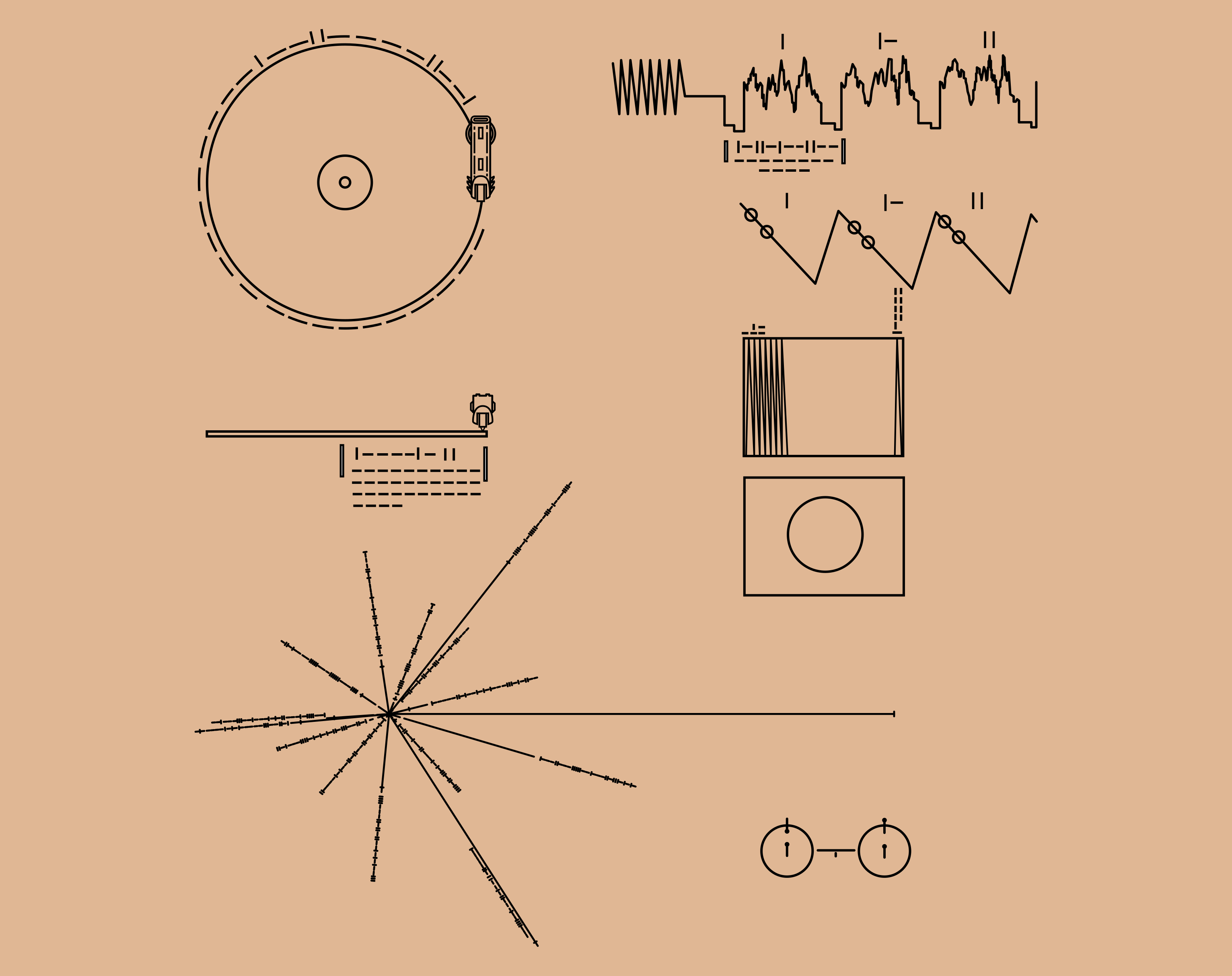
In 1977, Voyager 1 and 2 left Earth with a gold-plated copper record on board, filled with greetings, music, sounds and pictures from our planet. Long after the probes fall silent, they will keep sailing through space at almost 60,000 km/h, in the hope that someone, someday, intercepts one. Whoever does will also need to know how to play it, so the record’s aluminium cover is engraved with instructions written in diagrams and binary numbers. The artist Jon Lomberg, who helped curate the record and designed the cover, had to balance two requirements that are at odds: every diagram had to be as easy to understand as possible, while still packing in as much information as possible. The cover builds on the Pioneer plaque and goes one step further: it explains not only where the record came from, but how to get the sound off it and turn it back into images. Scroll down to decode the cover one diagram at a time, the way the Verge Science team did by hand.
That hyperfine transition releases a tiny bit of energy as a radio wave of 1420 MHz: the 21-centimetre line astronomers use to map our galaxy.
Converted into time, one wave lasts 7.04 × 10⁻¹⁰ seconds, or 0.7 nanoseconds. That single number unlocks every other symbol on the cover.
Fourteen lines run from our Sun to fourteen pulsars, collapsed stars that send out pulses of radiation with clock-like regularity. The binary code along each line gives the frequency of its pulses, which lets a finder triangulate where our Solar System is.
The map does not help to play the record, but it tells whoever finds it where in the universe it came from.
The binary number below it uses | for one and — for zero. Converted to decimal and multiplied by the 0.7-nanosecond hydrogen constant, it gives 3,229 seconds: roughly 53.8 minutes of playing time.
The broken ring around the edge is another binary number. Multiplied by 0.7 nanoseconds, it gives about 3.59 seconds: the time for one rotation, or roughly 16⅔ revolutions per minute.
Spin the record at that speed and it plays like any record on Earth: greetings in 55 languages, music from around the world, and sounds of oceans, birds, thunder and whales.
This diagram shows how to break that waveform up: each sharp drop marks the start of a new section, numbered 1, 2 and 3 in binary.
The binary number below gives the length of each section: about 8 milliseconds.
The sawtooth shows that motion. Each slope is one sweep from the top of the picture to the bottom, numbered 1, 2 and 3 like the sections of signal above, and each trigger snaps the beam back to the top. The circles sit at the same height on each slope: the same moment in each section lands at the same height in the picture.
The Verge Science team did this by hand. They selected each section between two peaks in Audacity, exported it as numbers to Excel, and used conditional formatting to colour quiet samples light grey and loud samples dark grey. It took 12 hours, and 512 repetitions.
Repeating that by hand for the remaining images was out of the question, so anthropologist Manuel Arturo Izquierdo wrote code that folds the 8-millisecond sections the way an old television would. The images appeared right away, proving the message can still be decoded 40 years later, with completely different technology.
- Record
- 30 cm (12 in) copper disc, plated with nickel and gold
- Cover
- Aluminium, with an ultra-pure sample of uranium-238 as a clock (half-life 4.468 billion years)
- Speed
- 16⅔ rpm, 3.6 seconds per rotation
- Playing time
- About one hour per side
- Images
- 116, analog, 512 vertical lines of about 8 ms each
- Sounds
- Greetings in 55 languages, sounds of Earth and music from many cultures
- Selected by
- A committee chaired by Carl Sagan
- Launched
- Voyager 2, 20 August 1977; Voyager 1, 5 September 1977
Decoding it yourself
Manuel published his decoder on GitHub as voyagerimb, and its notes add a few details the cover leaves out. He worked from a high-quality copy of the audio from David Pescovitz’s team, who had access to NASA’s original master tapes for their Ozma Records reissue: a 32-bit stereo recording at 384,000 samples per second. The left and right channels each carry a different image, so playing the record produces two pictures at once, even though the cover suggests a single signal. Each scan line spans about 3,197 samples, and because the analog equipment of 1977 was not perfectly regular, the alignment has to be tuned for every image. The signal also turned out to be upside down compared with the cover’s drawing, which leaves it ambiguous whether a value means black or white. None of that stopped the calibration circle from appearing on his very first attempt.
A message for the future
Etched by hand into the record itself is a short inscription: “To the makers of music – all worlds, all times.” The uranium-238 on the cover lets a finder work out how long ago the record was made, and the record also carries a message from then-president Jimmy Carter:
This is a present from a small, distant world, a token of our sounds, our science, our images, our music, our thoughts and our feelings. We are attempting to survive our time so we may live into yours.
Voyager 1, moving at about 17 kilometres per second, is the most distant object humans have ever made. In about 40,000 years, both Voyagers will pass within two light years of other stars. Whether anyone will ever find them is, for Jon Lomberg, beside the point:
Whatever happens to it in space, whatever its unknown destiny is, I think it represents a high-water mark of our civilization, when we dreamed the biggest dreams.
Jon Lomberg, in the Verge Science video
Sources and links
- Verge Science, We decoded NASA’s messages to aliens by hand (2018): the main source for the decoding walkthrough.
- Vsauce, Messages For The Future: the record’s inscription, Jimmy Carter’s message and where the Voyagers are heading.
- Wikipedia, Voyager Golden Record: background and technical details.
- Manuel Arturo Izquierdo, voyagerimb on GitHub: the decoder used in the Verge Science video, and the source for the audio details above.
- Ron Barry, How to decode the images on the Voyager Golden Record, Boing Boing (2017): the decoding effort that inspired the Verge Science video.
- Cover diagram: NASA, public domain. Vector version revised by Brian Krent (2015), via Wikimedia Commons.
- The companion post on the Pioneer plaque, whose hydrogen key and pulsar map return on this cover.
Inspiration
These three videos are what got me started on this project:
- melodysheep, Children of Planet Earth: The Voyager Golden Record Remixed (Symphony of Science)
- Verge Science, We decoded NASA’s messages to aliens by hand
- Vsauce, Messages For The Future